How to Paint a Front Door Without Brush Marks or It Sticking Shut.
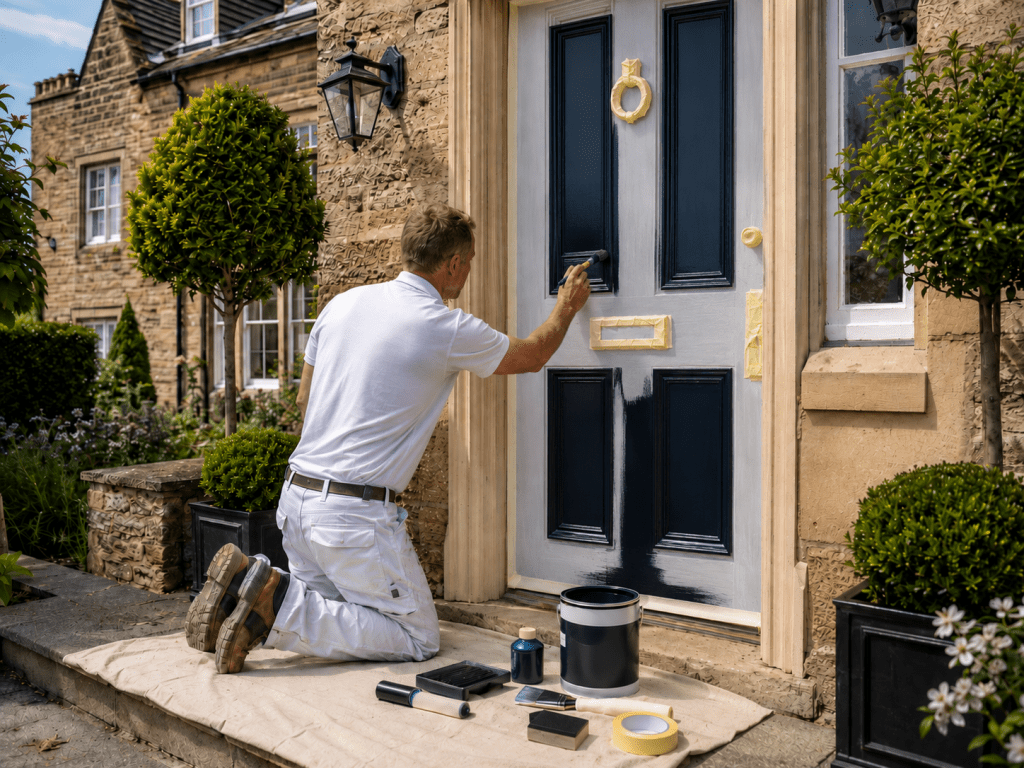
How to Paint a Front Door Without Brush Marks or It Sticking Shut
If you want to paint a front door without brush marks, sticky edges or a finish that looks rushed, the secret is not simply buying a better tin of paint. The real answer is the right system: good preparation, suitable weather, controlled coats, smoother paint flow and the correct tools.
A front door is one of the most satisfying weekend decorating projects you can tackle. It gives instant kerb appeal, makes your entrance feel smarter, and can lift the whole look of your home without a major renovation.
However, front doors are also unforgiving.
Too much paint, poor prep or the wrong brush can quickly lead to visible brush marks, sagging around mouldings, patchy coverage or a door that sticks to the frame overnight.
At Turner & Wood in Yeadon, we help customers from Guiseley, Otley, Ilkley, Baildon, Bramhope, Horsforth, Adel, Roundhay, Shipley, Leeds and Bradford choose the right exterior paint, primer, conditioner, tools and colour before the weekend starts.
Because a good front door finish is not luck. It is a system.
Can you paint a front door in a weekend?
Yes, you can usually paint a front door in a weekend, provided the door is sound, dry and not badly damaged.
The best plan is to prep carefully on Saturday morning, apply your first coat later that day, and then finish with a second coat on Sunday. However, you still need to leave enough time for the paint to dry before closing the door firmly against the frame.
A sensible weekend plan looks like this:
| Day | Job |
|---|---|
| Saturday morning | Remove or mask hardware, clean, sand and dust off |
| Saturday afternoon | Prime where needed and apply the first coat |
| Sunday morning | Lightly sand if needed, then apply the second coat |
| Sunday afternoon | Leave the door open as long as practical before gently closing |
Weather matters too. Ideally, choose a dry, mild day without blazing direct sun on the door face. Direct heat can make water-based paint dry too quickly, which often leads to dragging, brush marks and uneven flow.
Zinsser AllCoat Exterior Satin is listed as a water-based exterior paint suitable for wood, metal, masonry, plastic, concrete and cladding, with a recoatable time of around one hour in normal conditions. Zinsser AllCoat Exterior Satin
That quick recoat time is one reason it works so well for a weekend project.
Why front door paint jobs often go wrong
A front door works harder than most painted surfaces in your home.
It gets touched, knocked, rained on, heated by the sun, cooled by the wind and closed tightly against seals and frames. Therefore, even though the area is small, the finish needs to perform properly.
Most problems come from one of these mistakes:
- painting over grime, polish or old hand oils
- not sanding glossy surfaces properly
- using the wrong primer
- using poor-quality brushes
- applying paint too thickly
- painting in direct sun
- closing the door before the paint has hardened enough
The last two are very common. Paint can feel dry to the touch but still be soft underneath. As a result, the fresh coating may stick to the frame or weather seal when the door is closed too soon.
The best paint system for a front door
For many front door repaints, our core system would be:
| Role | Product |
|---|---|
| Main exterior finish | Zinsser AllCoat Exterior Satin or Gloss |
| Flow and brush-mark control | Owatrol Floetrol |
| Primer where needed | Zinsser Bulls Eye 1-2-3 |
| All-in-one alternative | Bradite One Can |
| Flexible multi-surface alternative | Bedec MSP |
| Tools | Hamilton or Arroworthy synthetic brush and mini roller |
That might look like a few options, but the logic is simple.
Zinsser AllCoat Exterior is usually the main exterior door finish. Owatrol Floetrol helps suitable water-based paint flow more smoothly. Zinsser Bulls Eye 1-2-3 supports adhesion where a primer is needed. Meanwhile, Bradite One Can and Bedec MSP are useful alternatives when the door or surrounding trim needs a different approach.
In other words, the best way to paint a front door is not always to use the same product on every door. The right system depends on the surface.
Why Zinsser AllCoat Exterior works well on front doors
Zinsser AllCoat Exterior Satin or Gloss is often our starting point because it is designed for exterior use and works across a wide range of common door surfaces.
Zinsser describes AllCoat Exterior Satin as suitable for wood, metal, masonry, plastic, concrete and cladding. It also forms a vapour-permeable, water-shedding coating and is recoatable in one hour. Zinsser AllCoat Exterior Satin
That makes it a useful choice for:
- timber front doors
- previously painted exterior doors
- suitable metal surfaces
- many uPVC or composite door projects, with the correct prep
- frames and surrounding exterior trim
For a softer, more contemporary look, choose satin. For a more traditional, dressier entrance, choose gloss.
However, the surface still matters. No exterior paint performs at its best over dirt, loose paint, chalky residue or a badly keyed glossy coating.
What about Bradite One Can or Bedec MSP?
Although Zinsser AllCoat Exterior is often our first conversation for a front door repaint, it is not the only good answer.
At Turner & Wood, we may also suggest Bradite One Can or Bedec MSP, depending on the door, frame and surface.
Bradite One Can is a strong choice when you want a practical all-in-one primer, finish and stain-blocking system. It is water-based, fast drying and suitable for many interior and exterior woods, metals and plastics. That makes it useful when the door or surrounding trim has mixed surfaces, old staining or a more awkward background. Bradite One Can
Bedec MSP is another excellent multi-surface option. It is designed for interior and exterior use and is self-priming and self-undercoating on many surfaces. Therefore, it makes particular sense when the job includes a mix of timber, metal, masonry, plastic, uPVC or previously painted surfaces. Bedec MSP
The important point is this: the best paint for a front door is not always the same product for every home.
A painted timber door in Ilkley, a uPVC door in Guiseley and an older stained door in Yeadon may each need a slightly different system. Bring us a photo and we will help you choose between Zinsser AllCoat Exterior, Bradite One Can and Bedec MSP before you start.
The smooth-finish upgrade: Owatrol Floetrol
This is where Owatrol Floetrol earns its place.
Floetrol is a water-based paint conditioner. It is not a standard thinner. Instead, it helps suitable water-based paints flow more easily, maintain a better wet edge and reduce brush and roller marks. Owatrol describes it as suitable for water-based paints, including interior and exterior emulsion and acrylic paints. Owatrol Floetrol
On a front door, that can be genuinely useful.
Water-based exterior paints can sometimes start to drag if:
- the door is warm
- the weather is breezy
- you are working in bright conditions
- the paint is drying quickly
- the door has panels and mouldings
- you are trying to lay off brush marks on a visible surface
Because Floetrol helps the paint stay workable for longer, you can brush, roll and lay off the finish more cleanly. That makes it especially helpful when you want to paint a front door with a smoother, more professional-looking result.
We would still treat Floetrol as a finish-improver, not a shortcut. You still need clean prep, the right paint and a decent brush. However, when used correctly, it can make water-based paint feel easier to control.
How much Floetrol should you add?
For brush and roller application, Owatrol guidance commonly recommends adding around 7–10% Floetrol per litre of water-based paint, with the option to increase gradually up to around 15% if the paint is thick or conditions are difficult. Owatrol Floetrol
In plain English:
- start small
- mix thoroughly
- test first
- do not overdo it
For a front door, we would usually suggest mixing a small test amount before adding Floetrol to your working paint. That way, you can check the feel, flow and finish before committing to the whole door.
Floetrol should only be used with water-based paints. Owatrol says not to add it to oil or alkyd-based paints.
One more honest note: Floetrol should not usually alter flat or semi-gloss acrylic finishes, but Owatrol’s technical guidance says it may reduce the sheen in gloss paints. So, if you want a high-gloss front door with maximum shine, ask us before adding it.
Satin or gloss for a front door?
Both finishes can look excellent, but they give different results.
Satin is softer, more forgiving and more contemporary. It works beautifully on modern homes, cottage doors, stone properties and front doors with slight imperfections.
Gloss feels more formal and traditional. It can look superb on a well-prepped door with brass hardware, especially in deep navy, black-green, oxblood, rich red or smart charcoal.
| Finish | Best for |
|---|---|
| Satin | Softer kerb appeal, modern homes, slight surface imperfections |
| Gloss | Traditional entrances, high-polish looks, very well-prepped doors |
When customers ask whether to use satin or gloss, we usually look at the surface first. A slightly imperfect door often looks better in satin. By contrast, a very smooth door can take gloss beautifully.
How to prep before you paint a front door
Good prep is the difference between a smart front door and a frustrating one.
Start by removing or masking door furniture. If you can remove the letterplate, knocker and handle, the final finish will usually look cleaner. If not, mask carefully with good-quality tape.
Next, clean the door thoroughly. Front doors collect hand oils, traffic film, cleaning spray residue, outdoor dirt and sometimes old polish. Paint will not grip properly if the surface is contaminated.
After cleaning, sand the surface.
For timber doors, sand with the grain and pay attention to glossy old coatings. You are not trying to destroy the surface; you are creating a sound key for the next coat.
Finally, dust everything off properly. A dusty door can spoil an otherwise good paint system.
When should you use Zinsser Bulls Eye 1-2-3?
Not every front door needs a separate primer, but many do.
Zinsser Bulls Eye 1-2-3 is a useful primer when you need better adhesion, improved coverage or a more controlled base before applying your exterior topcoat. Zinsser lists Bulls Eye 1-2-3 as quick drying, with a 30-minute drying time and a one-hour recoat time. It can also be tinted towards the colour of the topcoat in suitable situations. Zinsser Bulls Eye 1-2-3
Use a primer stage when:
- the old paint is very glossy
- you are changing colour dramatically
- the surface has mixed bare and painted patches
- you are painting certain plastics or tricky surfaces
- you want better hide under a deep topcoat
- previous adhesion is questionable
For bare knots, resinous timber, staining or more awkward surfaces, ask in store before choosing the primer. The right product depends on what is actually on the door.
How professionals paint a panelled front door
There is a proper order when you paint a front door, especially if it has traditional panels.
Professionals normally paint the internal recessed panels first, then gradually work outwards. That method helps you keep a wet edge, control the finish and avoid heavy ridges of paint building up around the mouldings.
A good order is:
- Paint the recessed panels first
- Brush carefully around the mouldings
- Paint the centre vertical sections
- Paint the horizontal rails
- Finish with the outer stiles and door edges
This method is especially useful with darker colours because every ridge, drag mark and missed edge shows more clearly.
Use a good synthetic brush for mouldings, edges and detailed areas. Then use a fine mini roller for flatter sections. After rolling, lightly lay off the paint where needed with the brush.
Do not overload the brush. Also, do not keep going back over half-dry paint. Instead, aim for two controlled coats rather than one heavy coat.
This is where the combination of Zinsser AllCoat Exterior, Owatrol Floetrol and a good Hamilton or Arroworthy synthetic brush really helps.
The paint gives durability. Floetrol improves the handling. The brush gives control.
How to avoid brush marks on a front door
Brush marks usually happen for one of four reasons: the paint is drying too quickly, the brush is poor quality, the coat is too thick, or the surface is being overworked.
To reduce brush marks:
- work in mild, dry conditions
- avoid painting in strong direct sun
- use thin coats
- keep a wet edge
- add Floetrol where suitable
- use a good synthetic brush
- stop brushing once the paint starts to set
Once paint starts to dry, leave it alone. Going back over tacky paint often makes the finish worse, not better.
Because front doors are so visible, tool quality matters. A cheap brush can leave tramlines, shed bristles and make even good paint look ordinary.
How to stop a freshly painted door sticking shut
Sticky door edges usually happen because too much paint has been applied, or because the door has been closed before the coating has hardened enough.
To reduce the risk:
- paint early in the day
- use thin coats
- avoid heavy paint build-up on the closing edge
- keep paint away from rubber seals where possible
- leave the door open as long as practical
- close it gently the first time
- avoid painting if rain, cold or damp conditions are likely
The latch side of the door needs particular care. A thick ridge of paint there is asking for trouble.
If the door has tight weather seals, mention this when you come into the shop. It may affect how we advise you to paint the edges.
What colour should you paint your front door?
This is where the job becomes more than maintenance.
A front door colour needs to work with the whole frontage of the house. Around Yeadon, Guiseley, Otley, Ilkley and Horsforth, we often see stone, brick, render and period details that respond beautifully to deeper, more considered colours.
Good front door colour directions include:
| House style | Colour direction |
|---|---|
| Yorkshire stone cottage | Deep green, bronze, off-black, muted red |
| Victorian terrace | Gloss black, oxblood, dark blue, smart olive |
| Modern rendered home | Charcoal, taupe, deep green, near-black |
| Red brick semi | Navy, dark teal, cream, sage |
| Period townhouse | Black, burgundy, blue-black, deep bottle green |
The colour should also connect with your hallway. If your door has glazing, the inside colour can affect how the outside feels.
This is where a colour consultation can help. A front door is a small area, but it has a big visual impact.
Turner & Wood weekend shopping list
For a smooth front door project, keep the setup focused:
| Need | Product |
|---|---|
| Exterior finish | Zinsser AllCoat Exterior Satin or Gloss |
| Smoother flow | Owatrol Floetrol |
| Primer where needed | Zinsser Bulls Eye 1-2-3 |
| All-in-one alternative | Bradite One Can |
| Multi-surface alternative | Bedec MSP |
| Brushwork | Hamilton or Arroworthy synthetic brush |
| Flat areas | Fine mini roller |
| Prep | Sanding pads, masking tape, cleaner, dust brush |
You do not need a huge basket of products. You need the right products.
That is the difference.
When to visit Turner & Wood before you start
Call into the shop before the weekend if:
- your door is uPVC or composite
- the old paint is glossy
- the door has knots or stains
- the frame needs painting too
- you want to use a dark colour
- the door gets full sun
- you are unsure between satin and gloss
- you want to use Floetrol but need mixing advice
- you want the door colour to work with your hallway
Bring a photo of the door, the full house frontage and the hallway if you can.
That gives us much more to work with than a colour card alone. It also means we can help you choose between Zinsser AllCoat Exterior, Bradite One Can, Bedec MSP and the right primer before you start.
Final advice
A front door refresh is one of the best weekend decorating projects you can do, but it rewards patience.
Clean properly. Sand carefully. Prime where needed. Use thin coats. Add Owatrol Floetrol when you want better flow from a suitable water-based paint. Then give the door time before closing it firmly.
For many projects, Zinsser AllCoat Exterior Satin or Gloss, Owatrol Floetrol and a good Hamilton or Arroworthy brush make a very strong front door system. However, for awkward surfaces, mixed materials or staining, Bradite One Can or Bedec MSP may be the better route.
So, before you paint a front door, bring a photo into Turner & Wood in Yeadon. We will help you choose the right paint, finish, colour and tools so your weekend project looks smooth, smart and properly considered.
We help customers from Yeadon, Guiseley, Otley, Ilkley, Baildon, Bramhope, Horsforth, Adel, Roundhay, Shipley, Leeds and Bradford get these jobs right first time.
FAQ section
What is the best paint for a front door?
For many front doors, Zinsser AllCoat Exterior Satin or Gloss is a strong option because it is designed for exterior use across multiple surfaces including wood, metal, masonry, plastic, concrete and cladding. However, Bradite One Can or Bedec MSP may be better for some mixed-surface or awkward jobs.
Can Floetrol help reduce brush marks?
Yes, Owatrol Floetrol can help reduce brush and roller marks in suitable water-based paints by improving flow, workability and wet-edge time. It is especially useful when paint starts to drag or dry too quickly.
Can I use Floetrol in gloss paint?
Floetrol can be used with suitable water-based paints, but it may reduce the sheen in some gloss finishes. Therefore, if you want a very high-gloss front door, ask Turner & Wood before adding it.
How much Floetrol should I add to paint?
For brush and roller application, Owatrol commonly recommends around 7–10% per litre of paint, with gradual increases up to around 15% if the paint is thick or conditions are difficult. Always test first.
Why is my front door sticking after painting?
A front door usually sticks because the paint has been applied too thickly, especially on the closing edge, or because the door has been closed before the paint has hardened enough.
Should I use satin or gloss on a front door?
Satin is softer, more forgiving and more contemporary. Gloss is sharper, more traditional and more reflective. The best choice depends on the condition of the door, the colour, the house style and the look you want.
Do I need to prime before painting a front door?
Sometimes, yes. If the surface is glossy, patchy, tricky, bare in places or changing colour dramatically, a primer such as Zinsser Bulls Eye 1-2-3 may help create a better base.
Can Turner & Wood help me choose a front door colour?
Yes. Bring photos of your front door, house frontage and hallway into Turner & Wood in Yeadon. We can help you choose a colour that works with your exterior materials, interior scheme and preferred finish.
choosing paint colours, colour consultation, farrow and ball, Little greene, paint and paper library, painting a front door